
Why Intentional Tech Is Having a Moment
Why Intentional Tech Is Having a Moment
A longer read on the cultural shift toward simpler phones — and why it’s not just a religious thing anymore.
Something strange is happening: people are voluntarily giving up their smartphones.
Not all of them, and not all at once — but the movement toward intentional, simpler, "dumber" technology has grown from a fringe curiosity into something you now read about in the New York Times, hear about on NPR, and see young people posting about (ironically) on TikTok before they quit.
At Kosher Cell, we’ve watched this from an unusual vantage point. We've started with building phones primarily for religious families who wanted technology aligned with their values. In the last few years, a growing share of our customers have nothing to do with that world. They’re software engineers burned out on their own industry. They’re mothers whose eight-year-olds begged for TikTok. They’re recovering addicts, writers who can’t finish books, parents of teenagers, and people just tired of being tired.
They’re all looking for the same thing: a phone that helps them live their life instead of replacing it.
What’s driving the shift
The case against the always-on smartphone has been building for a decade, but a few things have pushed it into the mainstream recently:
The research has caught up. Studies linking heavy smartphone and social media use to teen anxiety, depression, and sleep disruption have moved from academic journals into bestseller lists. Parents who shrugged off concerns five years ago are now actively looking for alternatives.
The phones themselves got worse. AI-generated content, algorithmic feeds that update every few seconds, and notification systems designed by teams of behavioral psychologists have made the average smartphone experience more addictive than it was even three years ago. The gap between "tool" and "trap" has widened.
Remote work changed the calculus. When your phone was the only way to be reached outside the office, you tolerated the distractions. Now that Slack, email, and calls all hit you everywhere, the phone’s ability to pull you away from your own life feels less like a feature and more like a cost.
The quiet success of "dumb" alternatives. The Light Phone sold out. Punkt. raised money. Unplug experiences became a genre. People started realizing that the binary isn’t "fully connected or off-grid" — there’s a middle.
What "intentional tech" actually means
The intentional tech movement isn’t Luddite. It’s not about rejecting technology. It’s about choosing which pieces of technology you want in your life and which you don’t.
A useful test: does this app or feature make my life better, or does it just make my phone more profitable for somebody else?
• Maps make your life better. They get you where you need to go.
• Your banking app makes your life better. It saves you a trip to the branch.
• WhatsApp makes your life better. It’s how you talk to family.
• An endlessly-refreshing feed of strangers’ opinions, designed to keep you scrolling past bedtime, does not.
• Neither does a shopping app engineered to make "just checking" turn into impulse buying.
• Neither does a newsfeed that shows you outrage because outrage keeps you looking.
Intentional tech is what happens when you get to keep the first group and lose the second.
What this looks like in practice
For some people, intentional tech means a traditional flip phone — calls and texts, nothing else. That works if you have a second device (a work laptop, an iPad) that handles everything else.
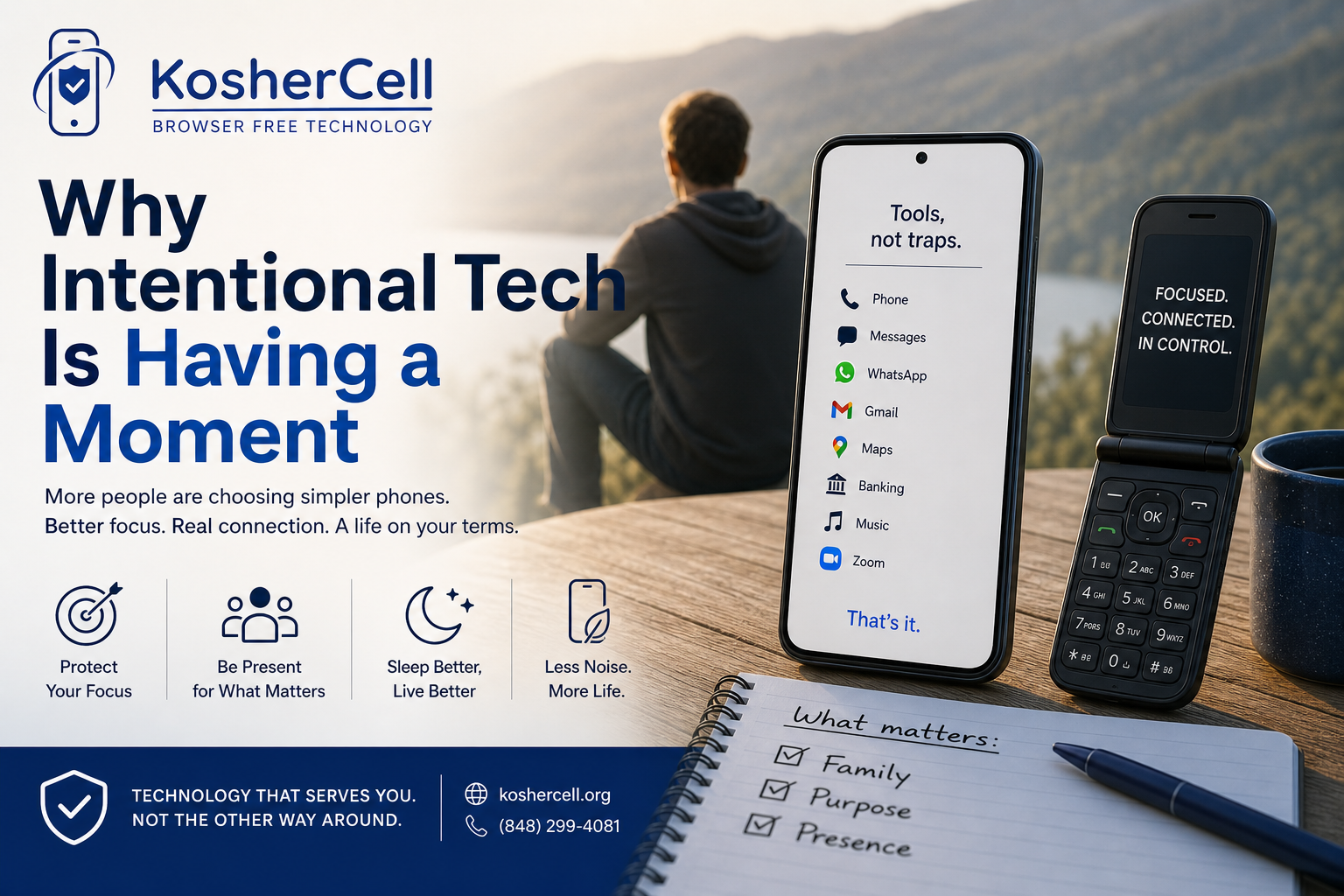
For most people, though, the right answer is a smartphone with the distractions removed. That’s what we build at Kosher Cell: Samsung, Pixel, and purpose-built kosher flip phones that handle the useful stuff — Gmail, Zoom, WhatsApp, navigation, banking, music — but have no browser, no social media, no open AI chatbots, and no way to add them back in casually.
The filter lives at the operating-system level, not as a browser extension or app you can swipe away. It’s the phone saying: you decided when you were clear-headed that you didn’t want these things; I’m going to hold you to that decision when you’re tired and bored.
Who this is for
Not everybody. If your job genuinely requires a social media manager’s phone, you’re not our customer. If you need TikTok to run your small business, keep it.
But a lot of people carry smartphones optimized for a life they don’t actually have — for a job that doesn’t require constant social feeds, for entertainment they’d rather spend on a book, for connectivity that crowds out presence. For them, a kosher phone or a dumbed-down smartphone isn’t a sacrifice. It’s a relief.
Getting started
You don’t need to go all the way on day one. A lot of our customers start by koshering a phone they already own — we strip out the distracting apps, keep the useful ones, and they use the same device they had yesterday, just calmer. Others switch to our flip phones for family time and keep a regular smartphone for work.
The point isn’t purity. It’s intention.
If you’re curious what this would look like for you, browse koshercell.org or call (848) 299-4081 and we’ll walk through the options.